1914–2000 in ten chapters: Mojsie Stobiecki's life at the scale he lived it, with documents, his voice, and the thread of life.
● Interview
■ Document
○ History
◇ Inference
scroll → · arrow keys navigate · Enter opens · the dots ● ■ ○ ◇ are clickable
→
1914
Kalisz
1914–1939compressed years — the scale here is smaller
THE WORLD
1939
The war
1939
THE WORLD
1941
Soviet Union
1940–1943
THE WORLD
1943
The army
1943–1944
THE WORLD
1945
The return
1945
THE WORLD
1946
Germany
1945–1946
THE WORLD
1947
Paris
1946–1947
THE WORLD
1947
Brazil
1947–1950
THE WORLD
1950
The life
1950–2000compressed years — the scale here is smaller
THE WORLD
∞
The fifth miracle
He numbered his miracles and never closed the series. The site closes it for him:
The fifth miracle
the fifth miracle is this family. From one survivor: three children, seven grandchildren, great-grandchildren — "1 survivor → 23 lives", as a great-grandson wrote in a school project. The lines go on.
"And God willing, there is still much ahead." [135:58]
the strand fades out — according to Mojsie himself, the family died at Majdanek [55:43]; the exact date is unknown. Marisha's thread does not end: it fades unconfirmed
03/06/1950
2
marriage to Clara
1952–1958
5
the three children
1977–1987
12
seven grandchildren
18/10/2000
12
he dies at 85; eleven descendants and Clara go on
hoje
23
"1 survivor → 23 lives" (slide 14)
⠿00:00
December 12, 1914
Born in Kalisz
Interview confirmed
Mojsie Izrael Stobiecki is born in Kalisz, Poland — a mid-size city of some 120,000, 30 km from the German border. Between 20 and 30% were Jews: the 1931 census would count 15,300, and his own estimate was right.
"Eu nasci na cidade, na Polônia, que se chama Kalisz."(translation) "I was born in a city in Poland called Kalisz."
The five children — and the card that documents them
Document confirmed
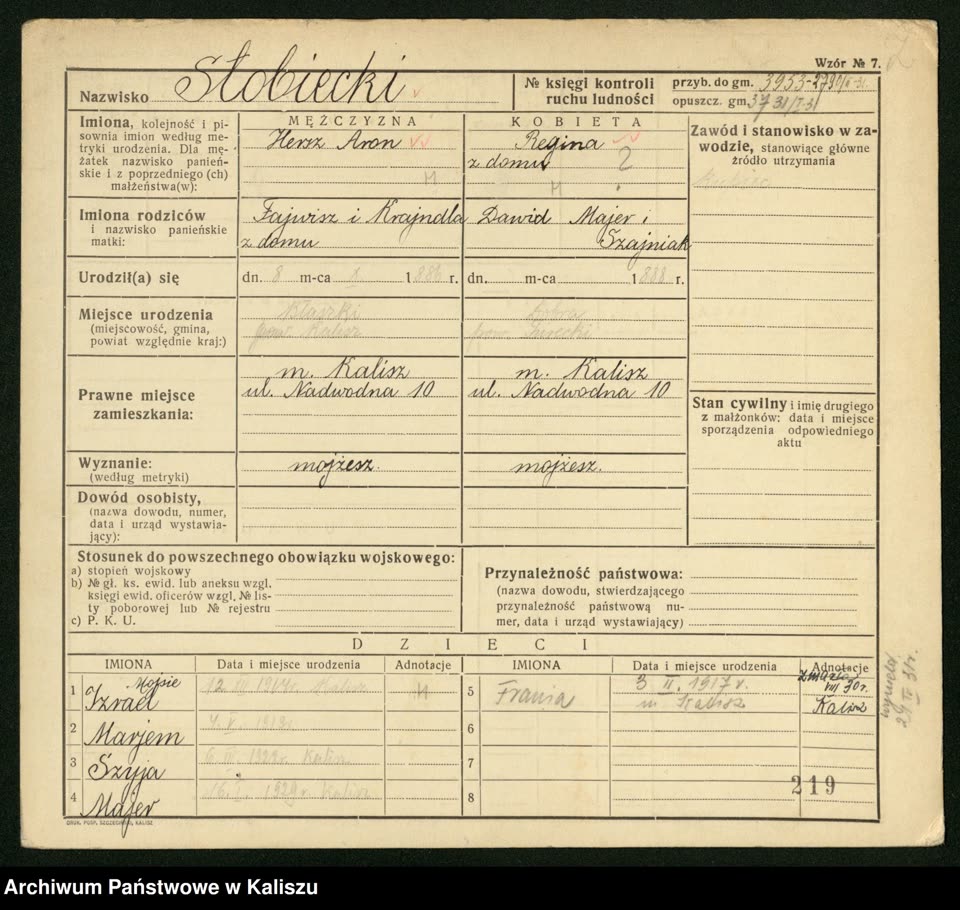
Stobiecki family registration card, Kalisz, c. 1934 — Archiwum Państwowe w Kaliszu, zespół 4463, karta 219
The family registration card (Kalisz State Archive, c. 1934) documents all five: Mojsie (1914), Frania (1917), Marjem "Marisha" (1919), Szyja (1922) and Majer (1929). By 1997 he could no longer recall the youngest one's name — "Majer" was recovered in 2026, with two independent confirmations.
"Meu irmão mais novo — fala a verdade, não me lembro o nome dele."(translation) "My youngest brother — to tell the truth, I don't remember his name."
Sources
AP Kalisz, karta 219 (D02)
ENTREVISTA 07:46, 127:50
August 1930
Frania dies at 13 — the sister no memory recorded
Document confirmed
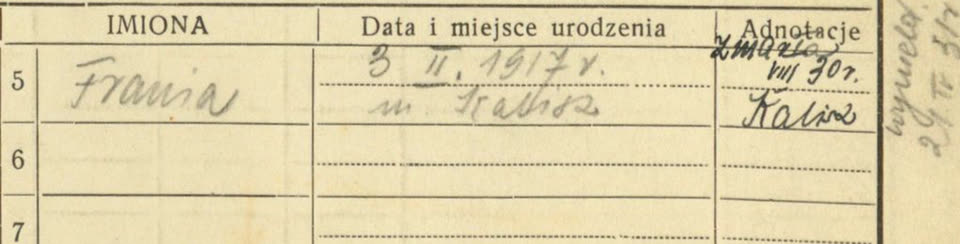
Card detail: Frania's line with the death annotation — AP Kalisz, karta 219 (detalhe)
An annotation on the family card: "zmarła VIII 30 r. Kalisz". Frania, the second child, died at 13, before the war. She is never mentioned in the interview, and the family did not know she had existed until August 30, 2026. Mojsie was 15.
Sources
AP Kalisz, karta 219
Nome recuperado em 30/08/2026
1920s
Cheder, community school, bar mitzvah
Interview confirmed
He enters cheder at seven; then the community school — mixed, in Yiddish, Hebrew and Polish. Bar mitzvah at 13, in the synagogue. At home, only Yiddish; the family was "liberal", but kosher and Sabbath-keeping.
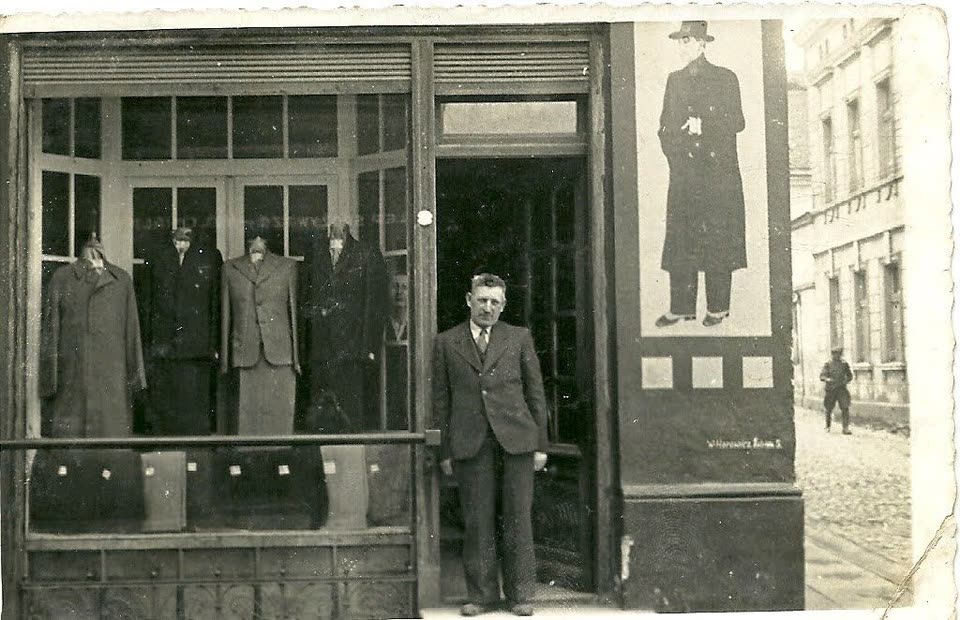
Herz Stobiecki at the shop door, 1936–37 — acervo da família (foto tirada pelo próprio Mojsie)
From very poor to well established: a clothing shop on Kanonicka, the home upstairs at 12 Parczewskiego St. The 1929 Polish Business Directory confirms it: "Stobiecki H., Nadwodna 12" — Nadwodna was the street's name until 1937.
"Essa foto eu mesmo tirei. Essa é da nossa loja que nós tivemos na Polônia, na Kalisz. Aqui está na porta meu pai."(translation) "I took this photo myself. This is the shop we had in Poland, in Kalisz. Here at the door is my father."
A member of Betar — Jabotinsky's Revisionist youth movement — and of Maccabi: uniforms, a flag, marches out to picnics. Zionism was the family's milieu.
About 30% of the city. One of Poland's oldest Jewish communities — settlement dates to the 12th century.
Sources
contexto/01-kalisz
1936–1938
The squeeze before the war
History confirmed the world
Pickets block the doors of Jewish shops; the market is segregated in 1937; kosher slaughter restricted in 1938. He remembers the fear of walking down the street. Two uncles read the moment and emigrate to Brazil while it is still the 1930s.
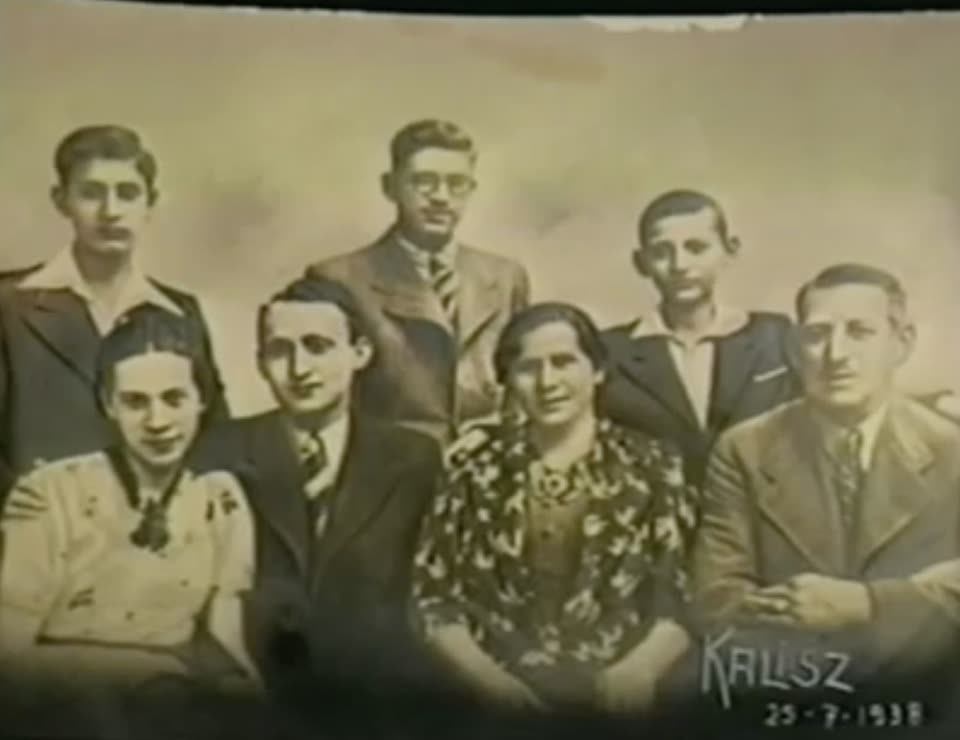
The Stobiecki family, Kalisz, July 25, 1938 — acervo da família
The only photo of them together. Standing: Szyja, Mojsie and the youngest, Majer (the two brothers identified by the family in 2026); seated: Marisha, her fiancé, Regina and Hersz. Thirteen months later the war began. Of this image, only Mojsie survived.
"Essa foto é minha família: são meus pais, meus irmãos e noivo da minha irmã. Meu pai chamava Hersh, minha mãe Regina."(translation) "This photo is my family: my parents, my siblings and my sister's fiancé. My father was called Hersh, my mother Regina."
Kalisz sits ~30 km from the border. On September 6 the city is occupied; violence against Jews begins at once.
Sources
contexto/04-setembro-1939
late August 1939
Mobilized — and his father's farewell in the street
Interview confirmed
His unit is posted near the border. In retreat, he passes through his own city and sends word to his father with a stranger. Herz finds him in the street and hands him a religious object and some money. It is his last memory of his father as a free man.
The retreat toward Warsaw, heavy weapons left behind, the train attacked from the air — each man with a carbine on his back, fleeing.
"A gente deixou todo armamento pesado lá, tudo que o exército pode ter de grandeza, tudo ficou lá, para que os alemães pegaram."(translation) "We left all the heavy weaponry there, everything an army can have of size, it all stayed there for the Germans to take."
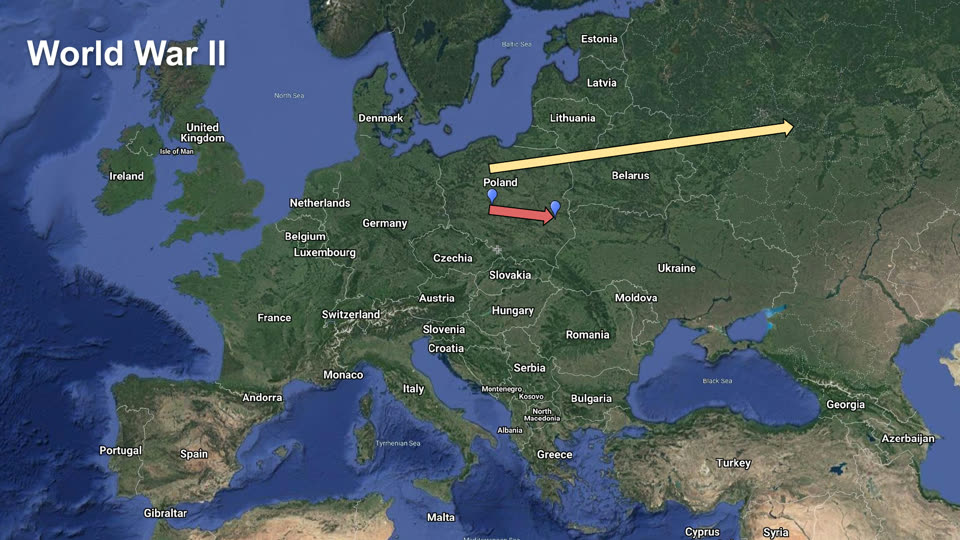
Poland is split between the two pact partners. The demarcation line will define his escape route.
Sources
contexto/04
late September 1939
Captured by the Soviets; escapes through tall grass
Interview confirmed
Taken by the Red Army in the rout, he slips away hiding in tall grass. At Sukkot he is taken in, with other soldiers, at the synagogue of Shedlitz (Siedlce, which he names in Yiddish).
Map of the 1939 escape — reconstrução da família (slide 5)
More than a month on the road back to Kalisz. On a train, two Germans hunt for Jews: he plays mute, and a Pole defends him. On the road, a German officer yanks him off the shoulder — "the second miracle". Near Błaszki, a man wearing Hitler's emblem hides him till dawn and walks him to the road — "the third". The first one he never names.
He reaches home and finds everyone alive. Notices on the corners order men his age to report. He proposes they all flee together; his parents refuse. He arranges for his brother to look after them — and says goodbye.
"Eu tinha 21, 22 anos. Meus pais: "Como eu vou fazer? Vou deixar tudo isso aqui?""(translation) "I was 21, 22. My parents: "How would I do it? Am I to leave all of this here?""
Mass expulsions of Kalisz's Jews begin — the wealthiest streets first, ten minutes to pack, the homes handed to Baltic Germans. More than 10,000 are locked inside the hala targowa, the covered market, ringed with wire; typhus sets in.
Sources
contexto/05-warthegau
December 2–14, 1939
The ten trains
History confirmed
Ten trains carry 15,862 people from Kalisz into the General Government: Lublin and Sandomierz first (Dec 2), then Kałuszyn, Łuków, Sarnaki, Sokołów, Węgrów, Łosice, Rzeszów, Kraków. The last leaves December 14 — two days after Mojsie's 25th birthday, spent already across the border. His family, living on a central street above their shop — precisely the profile targeted first — would have been expelled in this wave (a marked inference).
Sources
contexto/05 (Livro Yizkor de Kalisz; Dean/USHMM)
INFERÊNCIA sobre a família (grau: provável)
December 1939 – June 1940
Białystok, Soviet zone
Interview confirmed
He crosses to the Soviet side and lives as a civilian in Białystok, working at a restaurant.
In the great Soviet deportation of refugees (~75,000 people, 84% Jews), he is caught in a street roundup leaving work, birth certificate in his pocket. Sixty to a boxcar, plank bunks, a hole in the floor, salted fish and no water.
"Quando chegamos na nossa [estação], alguém começou, umas pessoas, gritando "água, água", começou todo o trem."(translation) "When we reached our [station], someone began — a few people — shouting "water, water", and the whole train took it up."
The first labor camp: outside a city, a commission arriving from Leningrad. The utterance is confirmed (he says "Kronstadt" four times); the place remains unidentified — consistent with Russia's north, main destination of the June 1940 wave (an inference). This is the stretch where his memory gives two versions; the chronology adopts this one.
The lie that saves him: "my father was a factory tailor"
Interview confirmed
An officer addresses him in Hebrew and asks his father's trade. He lies — a factory tailor — and says he can sew. They build a workshop from nothing, a tailor from Lodz teaching; they become Stakhanovites: better food, better beds. The sewing learned there will support him for the rest of his life.
Operation Barbarossa changes the fate of every deportee — and seals that of the family left in the General Government.
Sources
contexto/08
1941–1942
Siberia: 40 below
Interview confirmed
Evacuated to Siberia in sealed trains. A barrack with no toilet, field labor, 40 below zero. From this winter comes the sentence that names this site.
"Eu não sei, eu me pergunto sozinho: que jeito eu sobrevivi, que jeito eu estou aqui. Eu mesmo não. Eu acho que eu sobrevivi só para contar a história, viu?"(translation) "I don't know, I ask myself alone: how did I survive, how am I here. I myself don't. I think I survived only to tell the story, you see?"
Polish citizens in the USSR are amnestied; 90,662 Polish Jews leave camps and settlements by late 1942. In Central Asia the Anders Army forms — which the Soviets bar Jews from the annexed territories from joining.
Sources
contexto/09-anistia-anders
c. April 1942
Tashkent: "I am a Polish soldier, but I am a Jew"
Interview confirmed
Catholic Easter, an army lunch for the city's Poles. An officer orders Jews barred from the line. He refuses the order, is arrested and tried — and wins the case; the officer is transferred. Standing alone, inside his own army.
He names Karaganda and Tashkent on the way to the army. In his memory's first version, the 1940 train came straight here; the chronology adopts the second version (north first), for the three reasons noted in the timeline.
Under Soviet command, the Berling Army's division forms: 54,600 soldiers, some 2,400 Jews. First combat: Lenino, October 1943 — a quarter to a third casualties.
Sources
contexto/10-berling-lenino
1943
Back in uniform — under another command now
Interview confirmed
"When another president came, a communist president by then... so we marched along with the Russian army." No officer insignia: he explains in the interview why no one wore them — the memory of Katyń hovering unnamed.
He describes the siege, the hunger ("you couldn't find a cat or a dog anymore") and the trenches. But no Polish unit under Soviet command was at Stalingrad — his division formed three months after the battle ended. Recorded hypotheses: conflation with Lenino; an earlier labor battalion; a memory absorbed from his Soviet surroundings. Preserved as he told it.
Grenade shrapnel. They were going to amputate; he begs, and the hand is saved — a month in hospital, and the hand weak for the rest of his life. The same hand that sewed.
The first major camp captured nearly intact. Four months later it becomes the world's first concentration-camp museum.
Sources
contexto/11-majdanek
July–October 1944
He enters Majdanek
Interview confirmed
With the army, he sleeps in the just-emptied barracks. He describes the crematoria, the bones, the mountains of children's shoes, the endless pits. And he says, in his own words in the interview, that his parents and whole family died there — it is his statement; to this day no document confirms or contradicts it.
"E nós ocupamos lá e dormimos nas mesmas camas onde dormiram. E meus pais, minha e toda a família morreram lá."(translation) "And we were quartered there and slept in the same beds where they had slept. And my parents, mine and all the family died there."
Lublin's survivors ask the officers to release the Jewish soldiers for the holiday meal. They march into town in file — Jewish soldiers, sharing Yontef dinner with those who remained.
Passing through with the army, he finds a neighbor who survived. Her account: the building's caretaker denounced the goods hidden in the cellar; the Germans used Herz as a porter and, the animals unhitched, made him pull the cart in place of the horses. Everyone died. Only about Marisha she was unsure — she had been outside the camp.
"Eu encontrei essa sobrevivente e eu perguntei onde ele estava. Ela falou que ela estava morrendo com seus pais e irmãos. Todo mundo morreu, ela falou."(translation) "I found that survivor and asked where he was. She said she had been dying alongside her parents and siblings. Everyone died, she said."
The shop now sells hardware; in the house, a woman weeps
Interview confirmed
He returns to the shop and the house. The new tenant weeps and says Germans lived there before her. He looks for the caretaker, wanting revenge — and doesn't find him. An acquaintance invites him to lunch; he no longer wants to see the house, or the shop.
"Começou a chorar, e toda a família. Eu vi que ela não tinha a mesma culpa, e ele me contou também desse zelador. Esse zelador, eu procurava ele, eu queria vingança, mas não encontrei."(translation) "She began to cry, the whole family too. I saw the fault wasn't hers, and he also told me about that caretaker. That caretaker — I searched for him, I wanted revenge, but I didn't find him."
"I found it all empty. You only stepped on the photographs lying on the ground." Kalisz's 5,000-seat synagogue: "when I returned, I saw only ground".
"Encontrei tudo vazio. Só se pisava nas fotos que tinha no chão."(translation) "I found it all empty. You only stepped on the photographs lying on the ground."
Decorated with the Polish army's medal for bravery; discharged in Łódź. The physical medal was lost; the document too. His sentence closes the whole chapter.
"Eu ganhei do meu serviço como soldado a medalha, que sobrou só papel. Da minha família, que só sobrou também só papel."(translation) "From my service as a soldier I received the medal — of which only paper remained. Of my family, only paper remained as well."
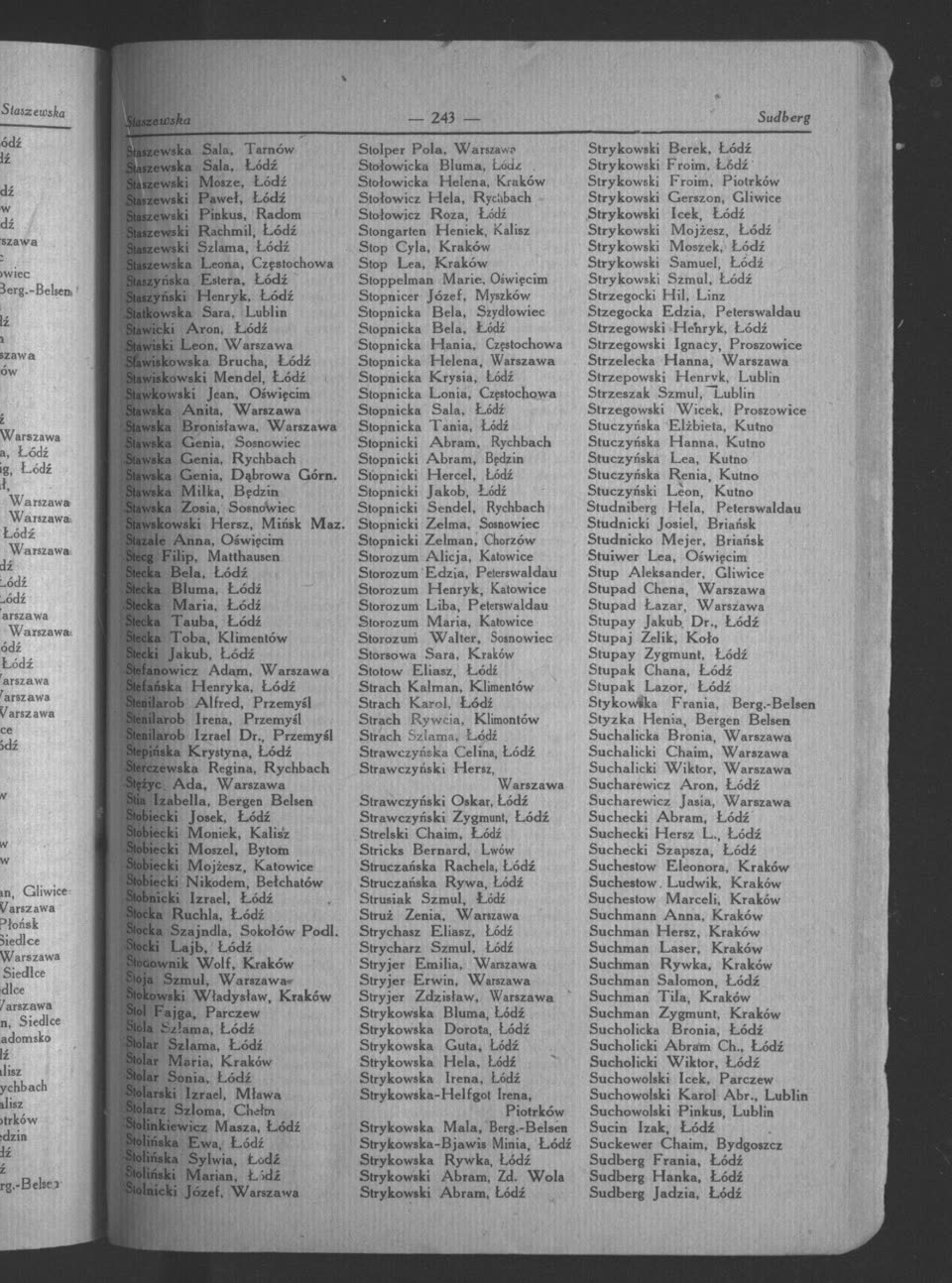
WJC Registry of Jewish Survivors, 1945, p. 243 — Arolsen Archives, doc. 78813849
He appears in the World Jewish Congress Registry of Jewish Survivors, listed in his own hometown — the documentary proof of survival, on page 243.
Sources
Arolsen 78813849 (D07)
1944–1945
The way back (map)
Inference probable
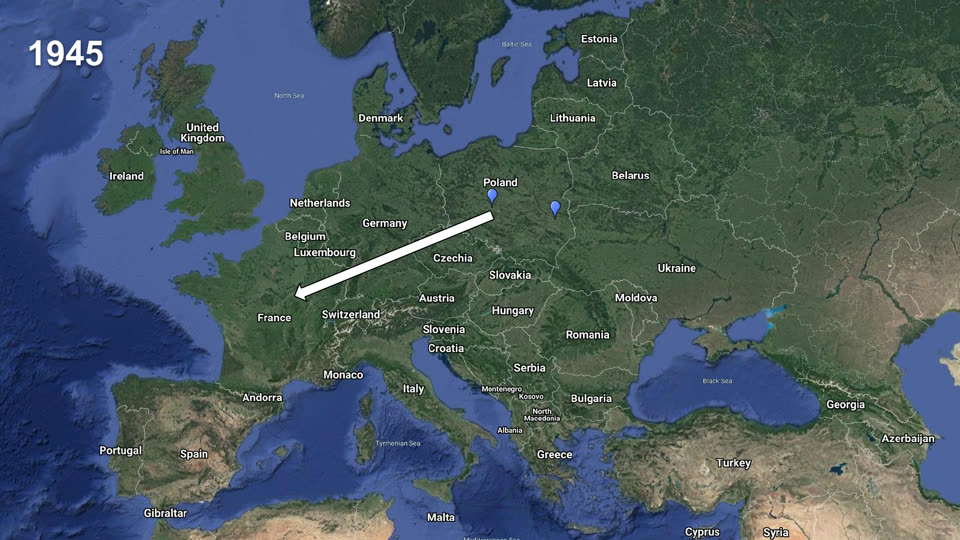
Map of the return, 1945 — reconstrução da família (slide 6)
The reconstructed route of the return with the army: Lublin → Warsaw → Łódź → Kalisz. The family's reconstruction from the interview.
Sources
slide 6
INFERÊNCIA
winter 1945–46
The crossing: 100 cigarettes and a liter of vodka
Interview confirmed
With no family and no home, he joins ex-soldiers and crosses the border — a kilometer of open snow to the forest, the bribe in his pocket. Then Frankfurt an der Oder, and "a while in Germany".
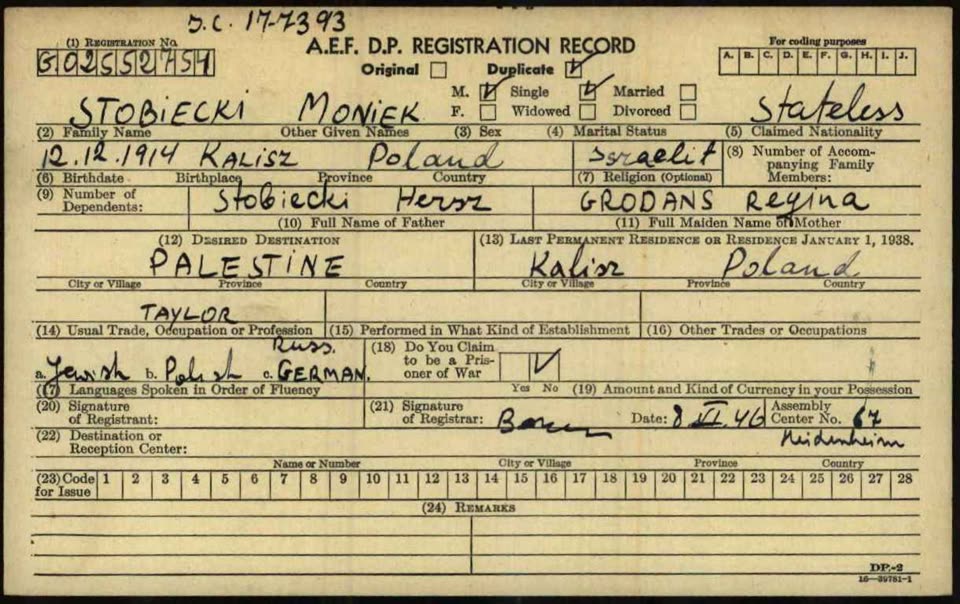
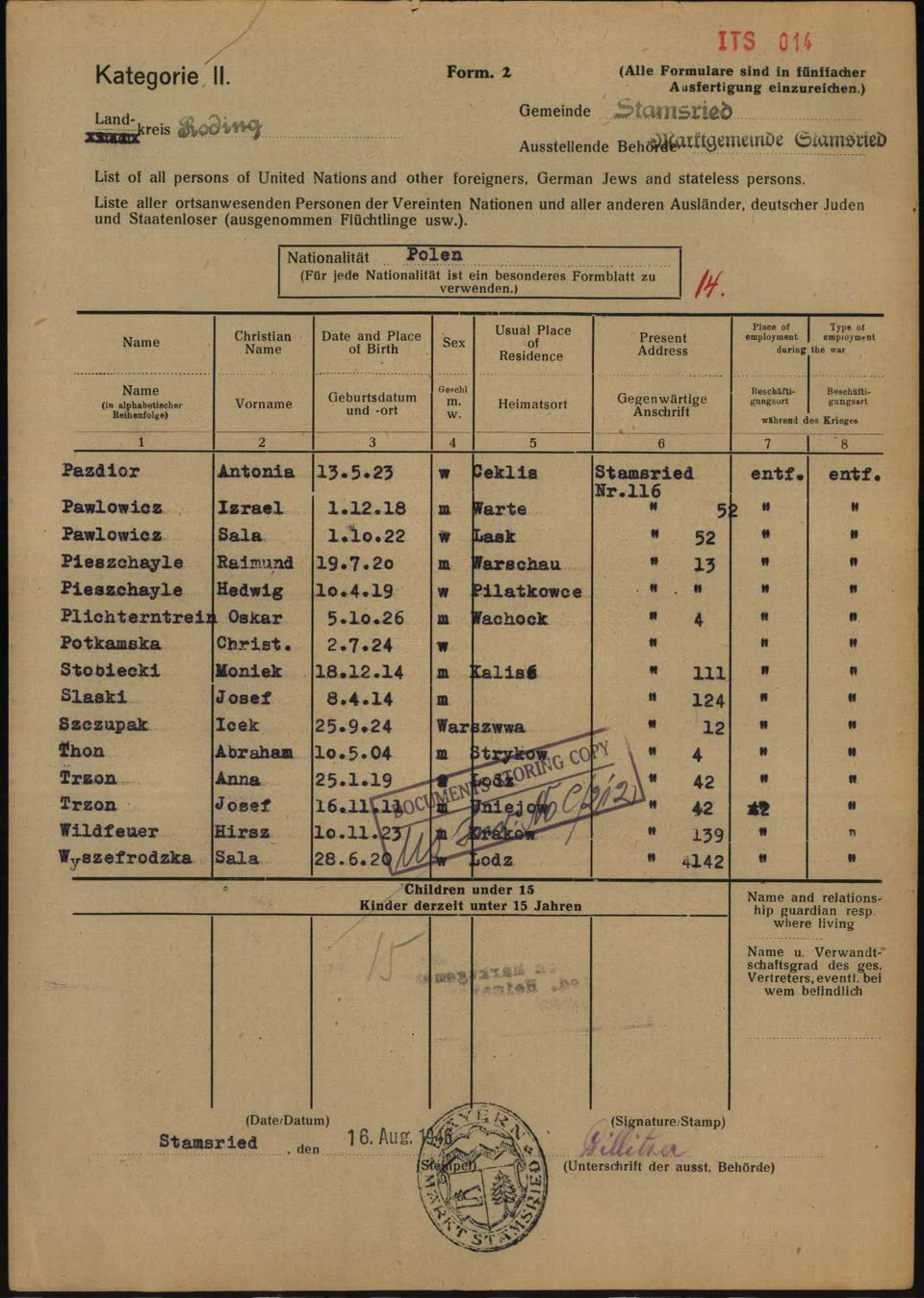
Registered at Assembly Center 67, Heidenheim an der Brenz: stateless, single, tailor; father Hersz, mother Grodans Regina — his mother's surname spelling, confirmed by this paper eighty years later. Desired destination: Palestine. The real destination would be another.
On the official list of the village of Stamsried, Landkreis Roding: a single name, no family beside it.
Sources
Arolsen 70200907
1946
Outside the Nuremberg gate
Interview confirmed
He watches the defendants enter and leave the trial. He names Goebbels and Göring — Goebbels is memory's anachronism (dead in 1945); Göring was there. The geography closes: Stamsried is ~100 km from Nuremberg, and he was in Bavaria precisely during the trial.
42 survivors murdered in postwar Poland. In the following months, ~100,000 Jews leave the country — the same wave that had carried him out.
Sources
contexto/13-retorno-1945
late 1946
Paris: the police in the middle of the night
Interview confirmed
First night in a tenth-rate hotel; a police raid before dawn. He is released for holding an ex-combatant's papers — those coming from the camps were being sent back to Poland. Once again, the army paper decides.
He works three months unpaid to learn trouser-making. Takes pains over a sample, lands work with an exporter; the Joint guarantees the credit for his first sewing machine. He ends up with a small workshop — seven in the morning to midnight.
Issued in Paris by the Polish consulate; days later, Brazilian visa no. 2529. A friend en route to the US had carried his name to Brazil: the answer came within two months — a cousin in Rio, the rest of the uncles' family in Porto Alegre.
Sources
DOCUMENTO (carteira de admissão)
ENTREVISTA 110:40
September 18, 1945
Decree-Law 7,967
History confirmed the world
Brazil conditions immigration on "suitable European ancestry". An estimated 15–20 thousand survivors got in anyway, many as "tourists". He entered as a temporary, under article 7-A of that decree.
Sources
contexto/16-brasil-imigracao
December 6, 1947
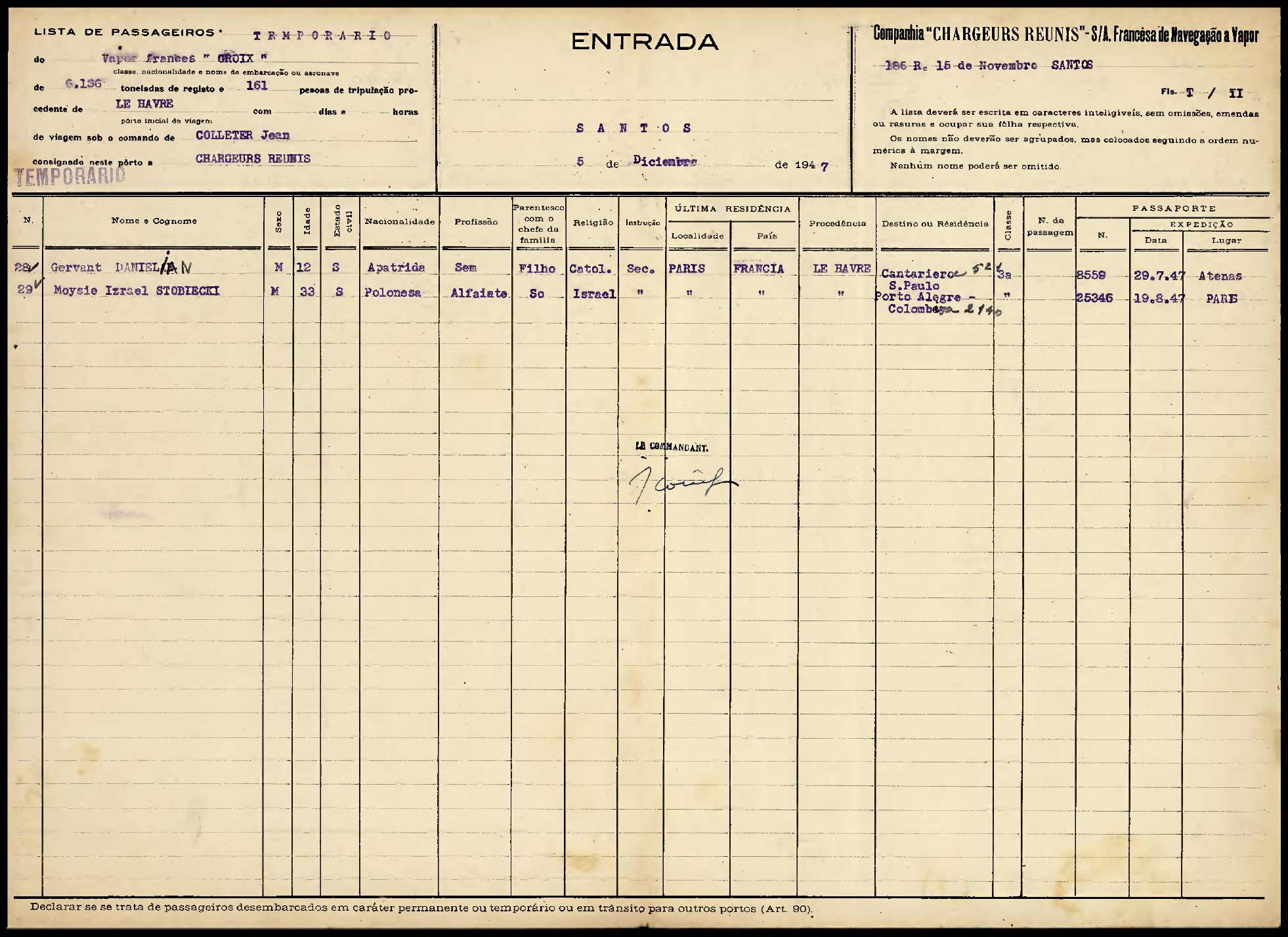
Santos: the steamer Groix, line 29
Document confirmed
Museu da Imigração/APESP, BR_APESP_MI_LP_110455
He lands at the port of Santos, from Le Havre via Casablanca and Rio — 3rd class, alone, "tailor", declared destination Porto Alegre. On the passenger list, page 13, line 29: "Moysie Izrael Stobiecki, 33, single, Polish". On the same page, eight other Polish Jews out of Paris.
In São Paulo he finds neighbors from Kalisz again — same street, same trade as his father's — and a Goldman who had worked for the family. Saturday dinners: a piece of Nadwodna street transplanted into the neighborhood.
He meets Clara Schnaider, from Curitiba, through São Paulo's Maccabi — her sister lived next to the meeting spot. He barely spoke Portuguese.
"Enquanto eu conhecia a Dona Clara, não sabia falar. Só... porque encostado morava a irmã dela."(translation) "When I met Dona Clara, I couldn't speak the language. Only... because her sister lived right next door."
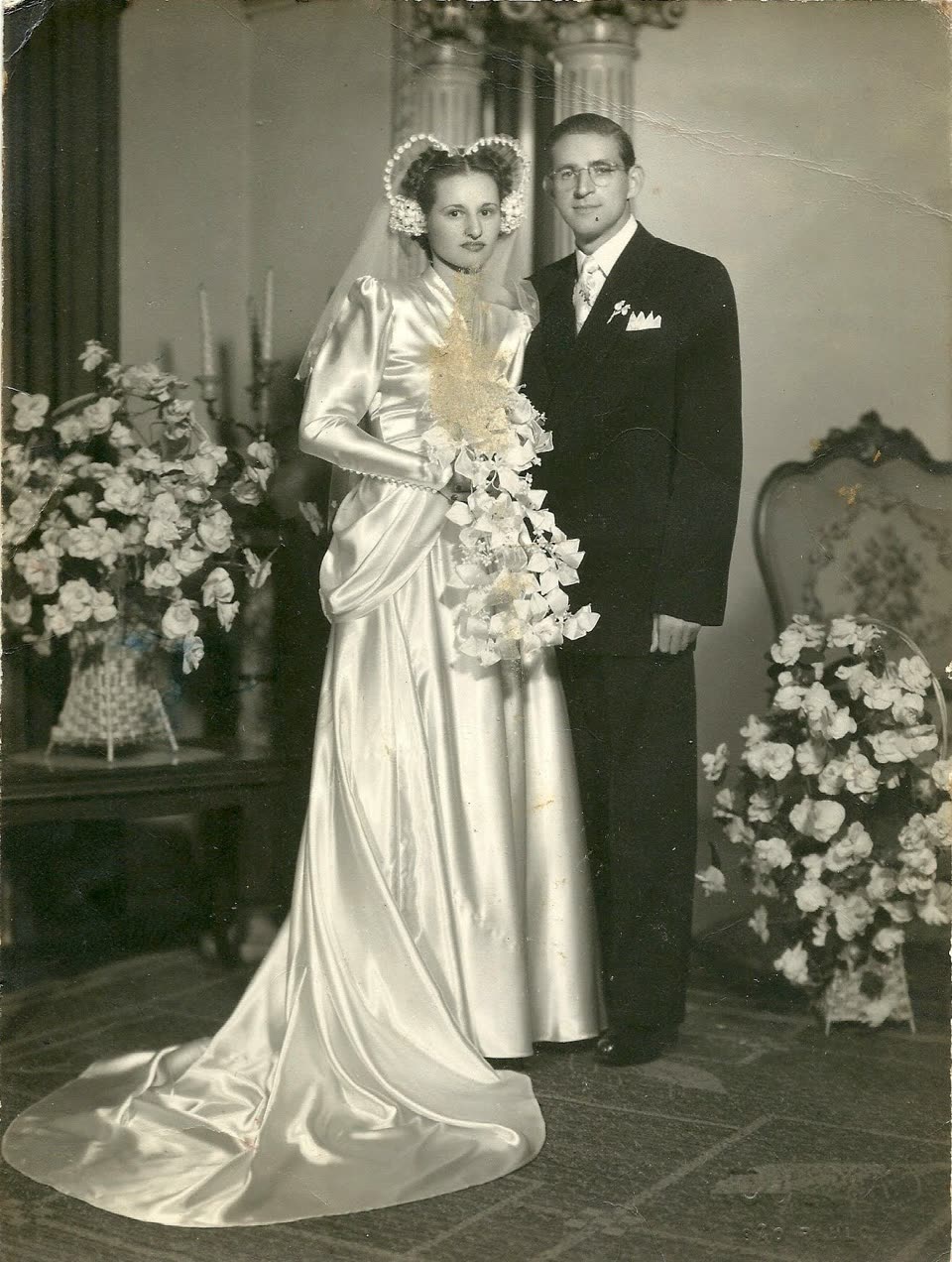
Mojsie and Clara at their wedding, 1950 — acervo da família
The banns run in the state gazette on May 18: "native of Poland… tailor, son of Herz Stobiecki and dona Regina". The wedding, June 3, 1950. The family the war erased begins, here, to be answered.
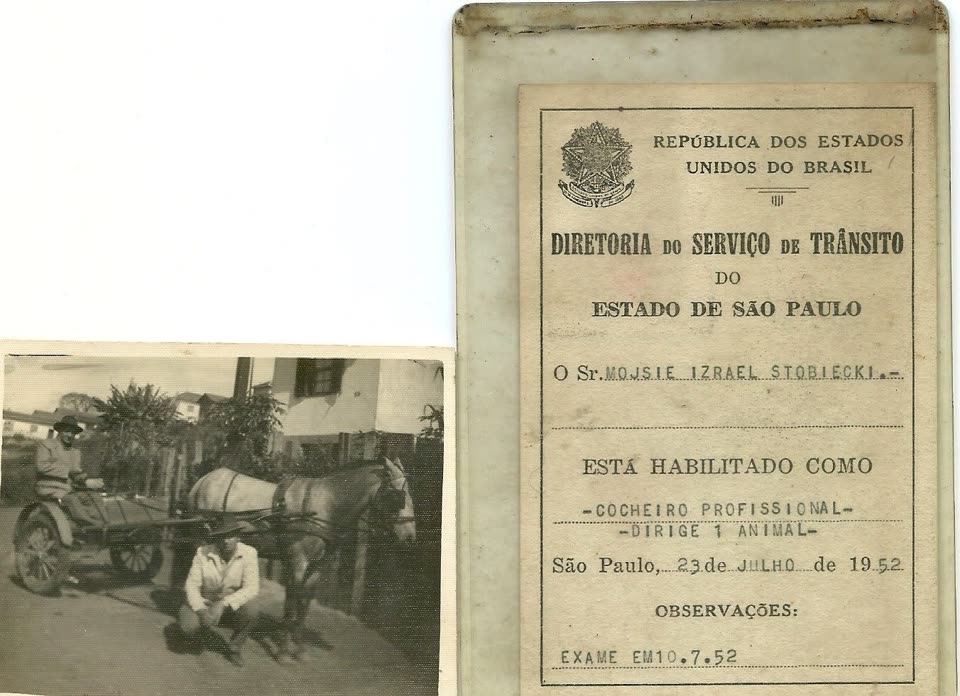
The São Paulo license. The tailor of Kalisz, Leningrad and Paris making a living by horse-cart in São Paulo — the collection's most unexpected document.
Sources
DOCUMENTO (slide 9)
1952 · 1953 · 1958
The three children
Interview confirmed
The three children. The thread that in 1945 was a single man begins to thicken again.
An eviction suit ruled against "Moyses Israel Stobiecki", recorded in the state gazette. A hard moment of material life, included here like everything else: unretouched. The rebuilt life had its winters too.
Sources
DOE-SP, 31/01/1969 (achados)
1977–1987
Seven grandchildren in ten years
Interview confirmed
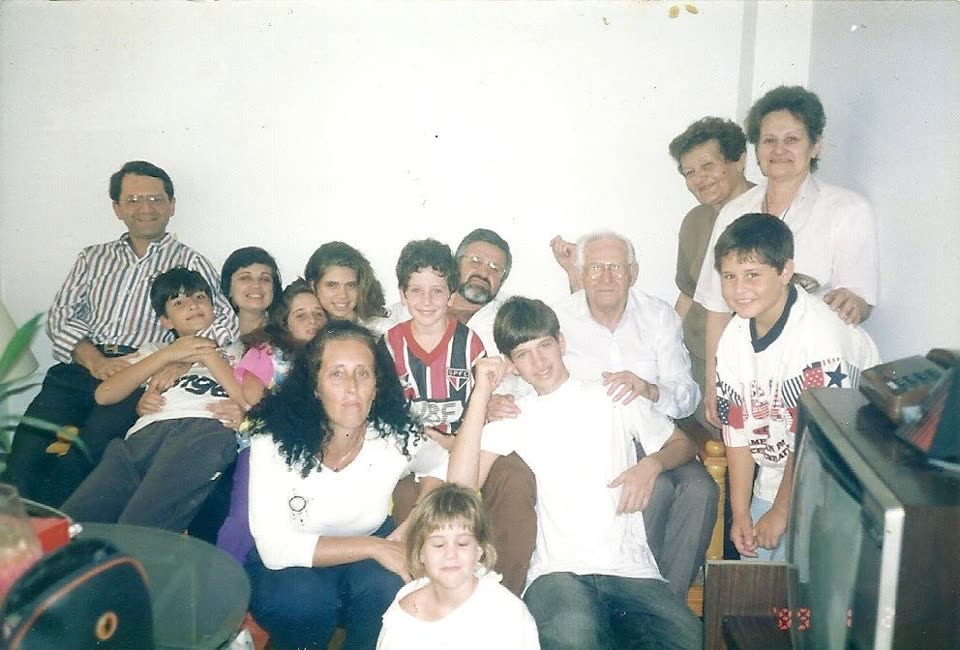
Seven grandchildren, from 1977 to 1987. In the interview he introduces them one by one, by name.
"Eu me senti no mundo sozinho, sem ninguém. Mas eu perguntei a mim mesmo: será que eu vou ter família outra vez?"(translation) "I felt alone in the world, with no one. But I asked myself: will I ever have a family again?"
Three generations in one photograph — the answer, in a picture.
Sources
acervo (slide 11)
November 25, 1997
He tells the story
Interview confirmed
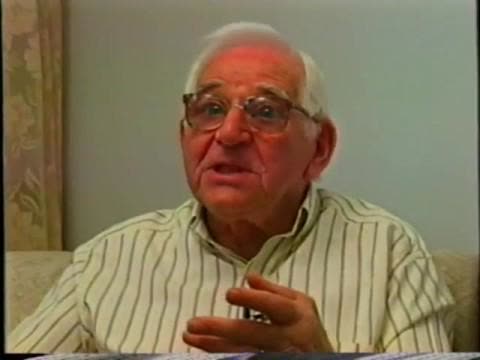
Still from the 1997 interview — USC Shoah Foundation, entrevista 35919
At 82, his family gathered in the living room, he gives his testimony to the Shoah Foundation — the 2h17 that are this site's spine. Months later comes the thank-you letter signed by Steven Spielberg. At the golden anniversary, June 3, 2000, the photo with Clara; on October 18 he dies, at 85.
"E estou muito feliz hoje que chegou essa hora, para me fazer essa idade e contar a minha história que eu contei. E Deus me dá esses anos. E se Deus quiser, ainda tem muita coisa em frente."(translation) "And I am very happy today that this hour came, to reach this age and tell the story I have told. And God gives me these years. And God willing, there is still much ahead."